Q&A with Dr. Versha Banerji: Turning perseverance into progress for patients

Dr. Versha Banerji’s road to cancer research has not been linear. Early in her studies, she dreamed of a career in research, only to see those plans derailed when the lab she worked in closed unexpectedly. Drawn instead to medicine, she spent her summers providing care in Nunavut and rural Manitoba, where she witnessed the inequities and barriers faced by patients in remote communities. Later, during her hematology rotation, she discovered a field that united her two passions — the science of cancer biology and the care of people living with blood cancers — and she’s never looked back.
Today, Dr. Banerji is a hematologist, clinician-scientist, and translational researcher based in Winnipeg, where she leads a patient-centred research program focused on improving access to safe, effective therapies for patients with chronic lymphocytic leukemia (CLL). Through the Marathon of Hope Cancer Centres Network, her team is exploring immune dysfunction in CLL to help shape more precise treatments for patients.
We spoke with Dr. Banerji about the experiences that shaped her journey, the lessons she’s learned from her patients and how Terry Fox’s perseverance continues to inspire her drive to push boundaries in cancer care.
Why did you become a cancer researcher? Was there a particular moment or experience that led to this decision?
That’s a long story. I have had a love hate relationship with research. When I was an undergrad, I wanted to be a researcher. I spent time in a research lab, but unfortunate events led to closures of the lab, and I lost my opportunity. I was turned off research, and while waiting to apply to medical school did a pre-masters in physiology in Cancer Biology. I learnt about TP53 and apoptotic pathways and was intrigued. But my negative experience in the lab led me to medicine. I spent my summers in Nunavut and rural Manitoba caring for people with less access to care and learnt the barriers they faced first-hand. I then rotated in Hematology and found a lab-based specialty where the materials I had learnt in cancer biology were being used to explain diseased states in blood cancers- it was truly love at first sight. The drive never stopped. I ultimately enrolled patients in trials later in my training and I was able to see the full effect of “bench to bedside and back”. It pushed me to take a risk, leave my hometown and pursue advanced training. I was a mom and wife.
Cancer research is difficult: progress is slow and for every step forward there may be quite a few steps backwards or sideways. What inspires you to keep going? What life lessons have you learned through cancer research?
Life is unpredictable at its best. It’s important to live it to the fullest. The people I care for and the people I meet often inspire me to do more and keep on going.
How would you explain your current research focus to a cancer patient or their family member?
I have a program of research that is patient-centred. We evaluate the health systems to ensure their journey is efficient and well supported. We also are leaders in implementation of novel treatments in the country. We evaluate their impact on clinical operational and economic impact. This ensures patients have safe and equitable access to therapies. I also run clinical trials in my institution trying to answer academic questions or bring novel therapies to patients in Canada. Finally, I also run a bench-based research program trying to understand the role of mitochondrial health in the biology of chronic leukemia cells and their survival. As a translational researcher I was able to put all these entities together for our Marathon of Hope cohort understanding immune dysfunction in CLL.
What impact do you hope your research will have on cancer treatment and outcomes for patients?
My hope has always been improving quality of life of patients through safe, effective therapies and state-of-the-art supportive care that addresses the person as a whole. To me, knowledge is power: if we don’t know something, then how can we address it?
Just like Terry Fox united Canadians nearly 45 years ago, the Marathon of Hope Cancer Centres Network is uniting researchers, clinicians, patients and administrators from cancer treatment and research institutions across Canada to accelerate precision medicine. How important is this collaboration and what impact do you think it could have on cancer research and treatment?
This collaboration will allow us to answer many questions at once with the power of the country’s best behind it. I have never been so excited by a collaboration such as this one.
If a researcher, clinician, patient or donor asked you why the Marathon of Hope Cancer Centres Network is important, what would you tell them?
For too long, we have functioned in silos. This opportunity enables a level of collaboration that hopefully accelerates the benefits for patients.
What does Terry Fox mean to you? How does Terry inspire you?
I am a Winnipegger, a woman of color in science and medicine and Terry Fox has inspired me for generations. He was different, he was tenacious and he persevered no matter the barriers. I have learnt to do the same.
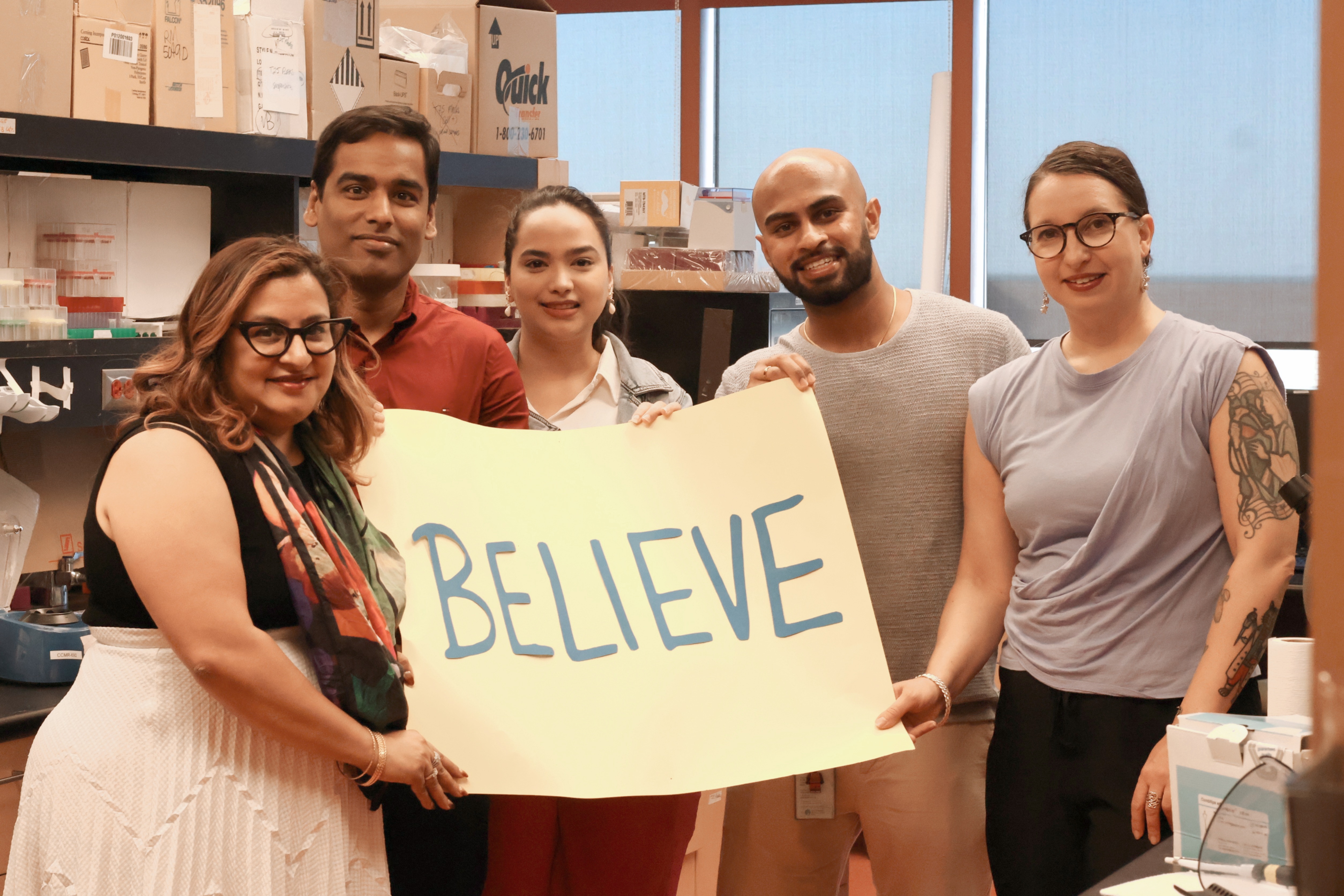
From left to right: Dr. Versha Banerji (Director, CLL clinical care, education and translational research unit: Dr. Prasanta Paul (Post Doctoral Fellow), Revanti Mukherjee (technician), Harshal Senthil (Research Associate) and Cheryl Peltier (lab manager, senior technician). Not pictured: Jenn Jochem (Director of operations CLL unit)
"I am a Winnipegger, a woman of color in science and medicine and Terry Fox has inspired me for generations. He was different, he was tenacious and he persevered no matter the barriers. I have learnt to do the same."
-
Regional Consortia
Prairie Cancer Consortium
The overall vision of the PR2C is to create a collaborative, inclusive, equitable, and sustainable multiprovincial initiative that works towards developing new treatment strategies for patients facing...Read more
-




Related News
-
“My own cancer journey gave me a new perspective on the Network’s mission”: A Q&A with Eileen Bruce, project coordinator of the Atlantic Cancer Consortium
Cancer has touched nearly every chapter of Eileen’s life. Today, she brings that lived experience to her work as a Project Coordinator and Patient Partner with the Atlantic Cancer Consortium, helping ... -

"Imagine being part of a movement where your voice helps shape advances in cancer research - that's my reality now"
Patient Working Group member Christine Qiong Wu produced this excellent explainer video highlighting the PWG's work and leadership within the Network. Christine emphasizes that the Network's collabora... -
Network Voices Conversations: Dr. Bishal Gyawali
Patient Working Group members Beverley Riediger and Dan Murphy speak with Dr. Bishal Gyawali about common sense oncology. -

Network Voices Conversations: Dr. Samantha Pollard
Patient Working Group members, James Pereira and Sheilah Brukewich, chat with Dr. Samantha Pollard about why patient values should be at the centre of precision oncology.


